
With a yearly release cadence that moves like clockwork, fall has become the most important time of the year for Qualcomm’s mobile SoC group. Making sure fall 2026 is no exception, the company this week announced its next-generation Snapdragon mobile chips at its annual Snapdragon Summit: the Snapdragon 8 Elite Gen 6 and Snapdragon 8 Elite Extreme Gen 6. Note: Patrick, our Chief Analyst, attended and Qualcomm paid for his travel, but I am writing this one.
The latest iteration of the company’s flagship line of Snapdragon 8 Elite chips, the Gen 6 parts are a mix of refinements and new feature additions to Qualcomm’s top chip architecture. The NPU and GPU blocks see major additions, with an emphasis on improving AI performance, while the chips get new wireless radios for both Wi-Fi and cellular. All the while, this generation introduces the latest generation of Qualcomm’s custom Oryon Arm-architecture CPU cores, bringing them to 5GHz for the first time.
| Qualcomm Snapdragon 8 Elite-Class SoCs | |||
| SoC |
Elite Gen 5
(SM8850) |
Elite Gen 6
(SM8950) |
Elite Extreme Gen 6
(SM8975) |
| CPU | 2x Oryon V3 Prime @ 4.6GHz 6x Oryon V3 Perf |
2x Oryon V4 Prime @ 5.0GHz 6x Oryon V4 Perf |
2x Oryon V4 Prime @ 5.0GHz 6x Oryon V4 Perf |
| GPU | Adreno 18MB HP Memory |
Adreno | Adreno w/Matrix Cores 18MB HP Memory |
| NPU | Hexagon | Hexagon w/Element Accelerator |
Hexagon w/Element Accelerator +50% Shared Mem |
| Memory Controller |
LPDDR5X 4x 16-bit @ 5300MHz 84.8GB/s |
LPDDR5X 4x 16-bit @ 5300MHz 84.8GB/s LPDDR6 |
LPDDR5X 4x 16-bit @ 5300MHz 84.8GB/s LPDDR6 |
| ISP/Camera | Triple 20-bit Spectra ISP
1x 320MP or 108MP with ZSL 4K120 HDR video capture |
Triple 20-bit Spectra ISP
1x 320MP or 108MP with ZSL 8K30 HDR video capture |
Triple 20-bit Spectra ISP
1x 320MP or 108MP with ZSL 8K60 HDR video capture |
| Decode | AV1, H.265, VP9 Decoding
Dolby Vision, HDR10+, HDR10, HLG |
AV1, H.265, VP9 Decoding
Dolby Vision, HDR10+, HDR10, HLG |
APV, VVC, AV1, H.265, VP9 Decoding
Dolby Vision, HDR10+, HDR10, HLG |
| Integrated Radio | FastConnect 7900 Wi-Fi 7 + BT 6.0 2×2 MIMO |
FastConnect 8800 Wi-Fi 8 + BT 6.0 4×4 MIMO |
FastConnect 8800 Wi-Fi 8 + BT 6.0 4×4 MIMO |
| Integrated Modem | X85 Integrated 3GPP Rel 18 (5G Adv Sub-6 + mmWave) |
X105 Integrated 3GPP Rel 19 (5G Adv Sub-6 + mmWave) |
X105 Integrated 3GPP Rel 19 (5G Adv Sub-6 + mmWave) |
| Mfg. Process | TSMC N3P | TSMC N2P | TSMC N2P |
But architecture aside, the Elite Gen 6 chips also come with some pretty big changes to how Qualcomm is organizing its product line as well. After experimenting with multiple tiers of Elite chips in Gen 5 with the V-series – a version of the S8GE5 with a smaller GPU – Qualcomm is expanding on that strategy with Gen 6. Now we have two tiers of chips: the Snapdragon 8 Elite Extreme Gen 6, which is the fastest and most feature-rich Gen 6 SKU, and the Snapdragon 8 Elite Gen 6, which is a little less extreme, coming with fewer features than the Extreme chip. In that respect, this is a notable departure from Qualcomm’s earlier experiments, as they are differentiating based on features rather than raw performance.
With the Snapdragon 8 Elite Gen 6 not only setting the stage for Qualcomm’s high-end mobile offerings next year, but also giving us a look at the direction the company will take its PC chips, this week’s announcement gives us a lot to look into. So let us get started.
Qualcomm Elite Gen 6 Construction: New Process Node & Offset Packaging
Before we even get to the Elite Gen 6 architecture, we need to talk about manufacturing and packaging.
Qualcomm has historically kept its flagship Elite chips on cutting-edge process nodes, and 2026 is no exception. This year in particular is especially pivotal, as Qualcomm has moved the chip line to TSMC’s brand-new 2nm performance process node, N2P.
More than just being the latest and greatest of TSMC’s process nodes, the N2 generation marks an important inflection point for TSMC-fabbed chips. This is the company’s first GAAFET process node, replacing FinFET technology with gate-all-around transistor design. A change years in the making, GAAFET technology has delivered impressive gains in both transistor performance and density, breathing new life into transistor scaling after chip designers hit diminishing returns on 3nm FinFET nodes.
GAAFET has especially benefited SRAM scaling, which is particularly important to mobile chips as SRAM caches play a huge part in their power efficiency. We have also seen it fare very well across both TSMC and Intel clients on the clock speed front, which is always an important tool for improving single-threaded performance. Qualcomm is putting both improvements to good use in the Elite Gen 6 family.
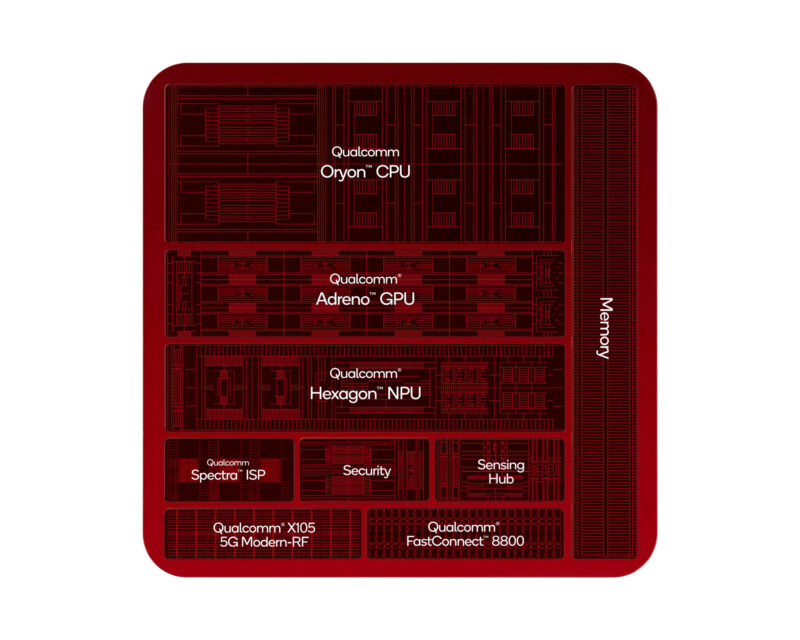
More than anything else, the shift to 2nm and GAAFET transistors is a once-in-a-generation kind of improvement on the chip manufacturing side of matters. Qualcomm uses a newer process node with every generation of the Elite family, but the shift to GAAFET is far more significant than the usual node improvements over the last several years.
Meanwhile, the Elite Gen 6 family also brings notable packaging changes. Qualcomm has moved to offset package-on-package (PoP) die placement, shifting away from placing the on-package DRAM dies directly on top of the SoC logic die. Instead, those memory dies have shifted to the side of the chip (and hence offset) so they no longer cover the hottest portions of the logic die, such as the CPU and GPU cores.
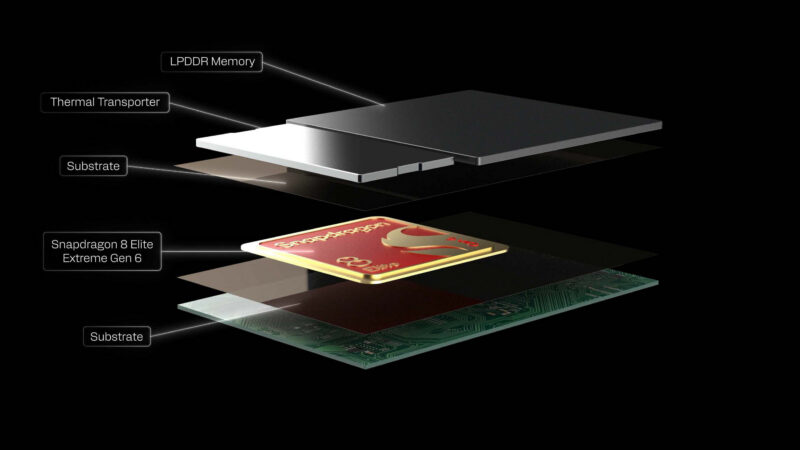
In its place, Qualcomm is putting a heatsink (technically what they term a “thermal transporter”) over the now-exposed areas of the logic die in order to better cool the hot spots and to keep the overall chip package level with the memory dies. The trade-off is that this is less space-efficient overall. It is effectively going backward in 3D construction by not stacking dies quite as much, but it allows Qualcomm to address one of the biggest downsides of traditional PoP designs: the memory dies inhibiting cooling of the hotter logic die.
Ultimately, this should allow the Elite Gen 6 chips to run at higher clock speeds for longer, before having to throttle back from the heat buildup throughout the rest of the phone. Here Qualcomm is advertising a two-fold increase in how long an Elite Gen 6 chip can maintain its peak performance.