
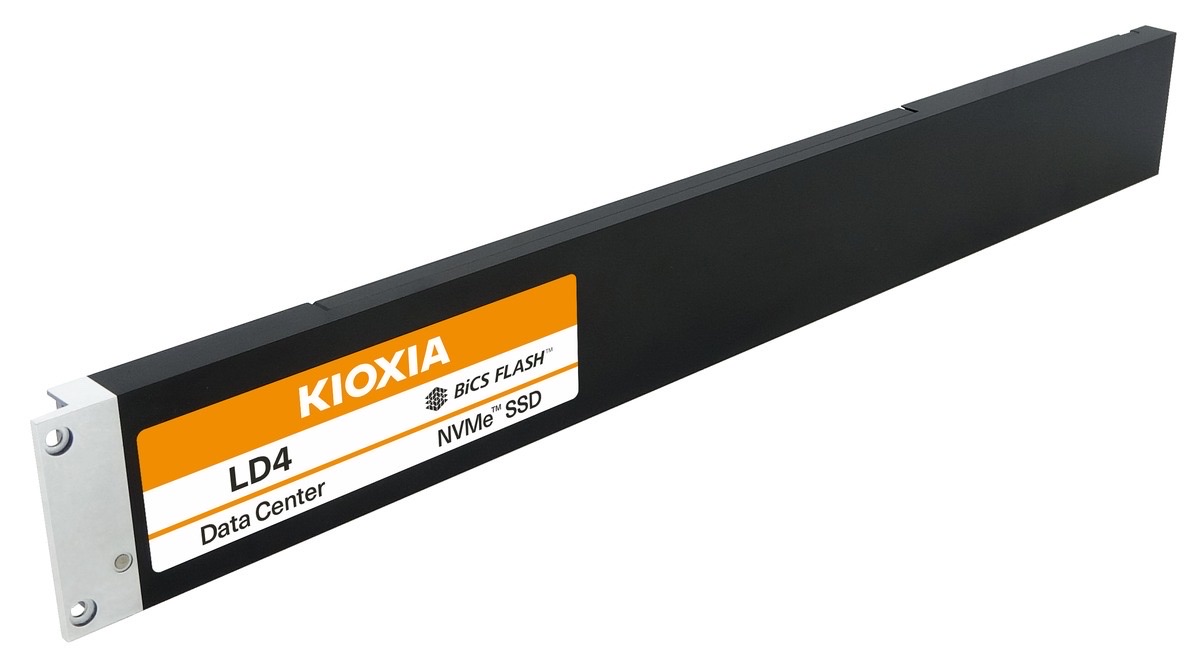
Kioxia has introduced its first E1.L form factor SSD, built with BiCS FLASH generation 8 QLC flash memory. We did a piece a few days ago showing BiCS under a microscope. Kioxia is targeting read-intensive hyperscale workloads in high-density 1U scale-out servers with the LD4 Series, launching at 15.36TB and 30.72TB with a validated architecture the company says supports up to 122.88TB. For “ruler” SSD fans, this should be exciting, but it also shows some clear industry trends.
Kioxia LD4 E1.L QLC SSD Announced
The Kioxia LD4 is clearly a read-focused drive. It uses QLC NAND to boost capacity at the expense of raw speed. E1.L uses a 9.5mm thickness and a 318.75mm length, a shape designed to put more flash capacity into a 1U chassis by extending the depth for longer PCBs and therefore more NAND sites. We covered this in our EDSFF primer years ago.
Although PCIe Gen6 servers have started to arrive in the STH lab, this is still a PCIe Gen5 NVMe SSD. Our sense is that storage applications, especially those using QLC NAND will be slower to transition to Gen6 than the drives we see in GPU nodes.
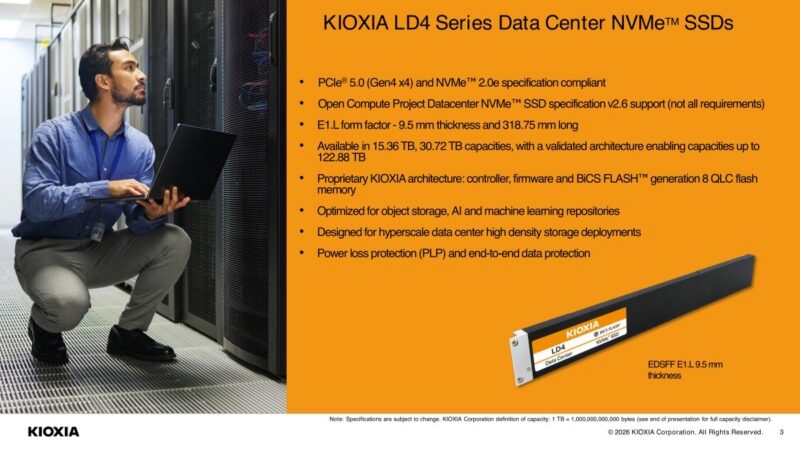
At launch, Kioxia is offering 15.36TB and 30.72TB models, while the company says the underlying architecture has been validated for capacities up to 122.88TB.

As a “D” series drive, we know that this is designed for hyperscale data centers. The LD4 is a single-port design and is apparently already sampling.
Final Words
While folks are looking at E3.L and E2 for capacity, this form factor matters for 1U servers, where you can either use less front panel space for a given capacity or cram more drives in. Two 30.72TB 9.5mm E1.L drives do not take up much front panel area, so if you are building front-cabled servers, that is important. Also, if you look at ORv3 racks that have power, liquid cooling, and in-rack interconnect in the rear, you can quickly see how having capacity in a 1U-compatible E1.L drive can make a lot of sense. Hopefully we get to see more at OCP Summit next week.