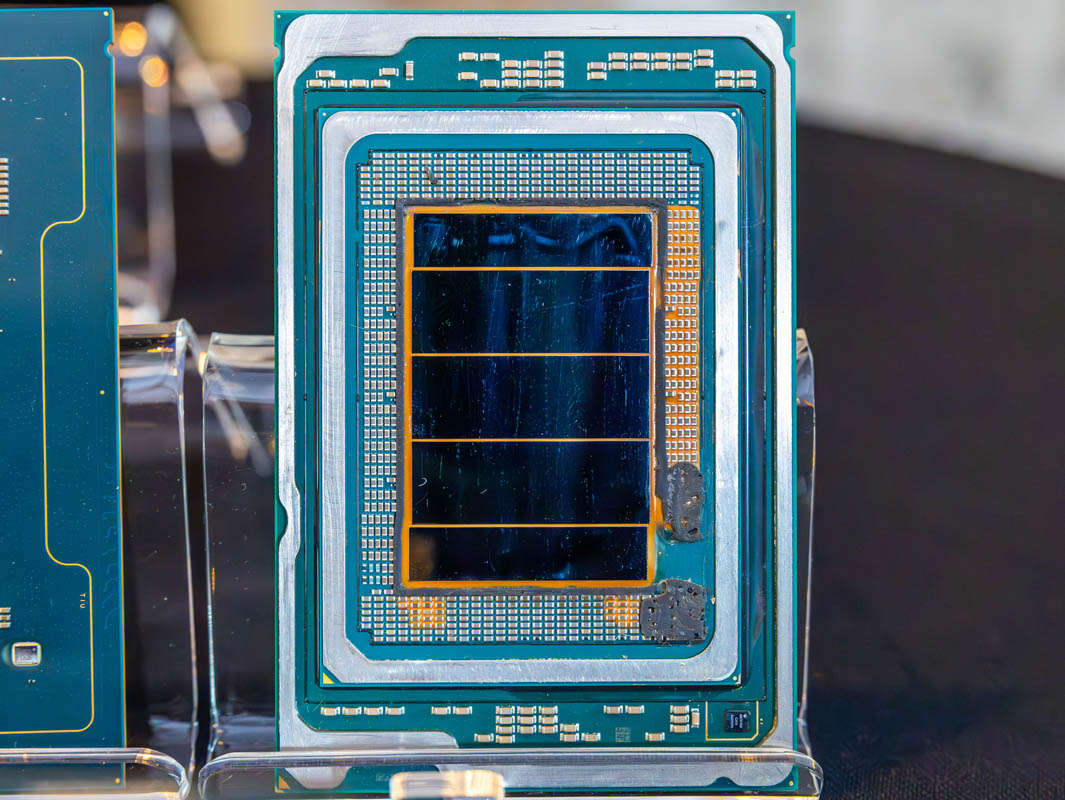
Intel is finally shipping its Xeon 6+ processor family, codenamed Clearwater Forest. These new chips target the Xeon 6900 series AP (accelerated processor) platforms currently available with the Xeon 6900P series. They are also a successor to the Sierra Forest Xeon 6700E series SP (scale-out processor) that launched earlier, and the Sierra Forest-AP 6900E series that became a hyper-scale-only chip. While Sierra Forest was a first-generation E-core design for cloud-native workloads, Clearwater Forest focuses on delivering higher per-core performance and dramatically more L3 cache in an E-core-only design, with up to 288 cores per socket. Intel built the Xeon 6+ E-core line specifically to combat the threat of smaller, lower-cost Arm cores for cloud native workloads. This is Intel’s answer to keep those workloads on x86.
The Long Road to Get Here
If it feels like you have been hearing “Clearwater Forest” for a long time on STH, you have. We started covering Intel Clearwater Forest over two years ago.
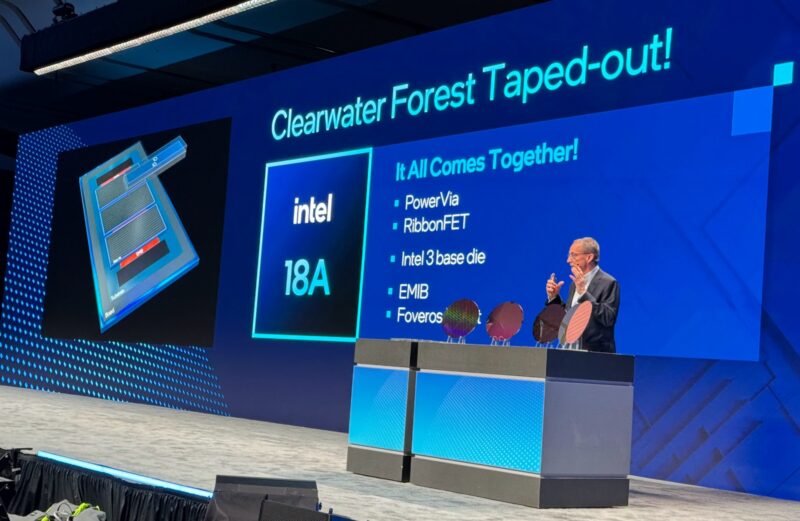
We showed it to you later in 2024, and did a deeper dive with Intel Xeon Clearwater Forest with 288 Cores on Intel 18A at Hot Chips 2025.
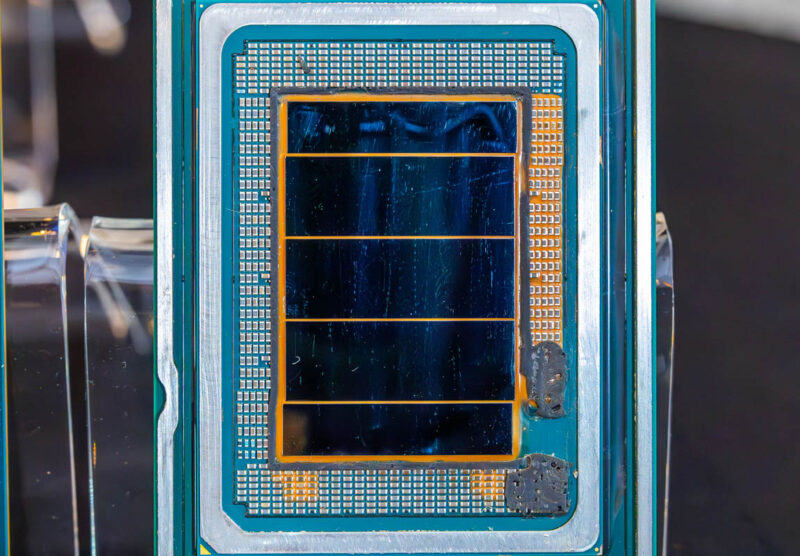
Now, after what feels like almost an eternity of waiting, or what would have felt like that had we not gone through Ice Lake, Clearwater is here for many customers.
Clearwater Forest Architecture and Specifications
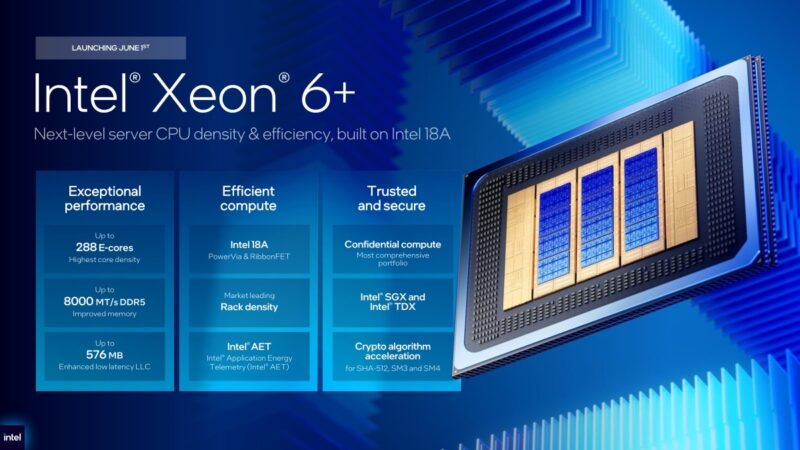
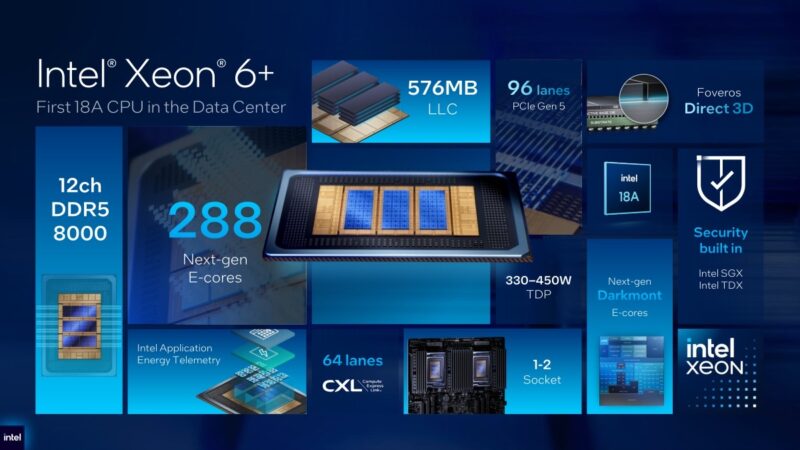
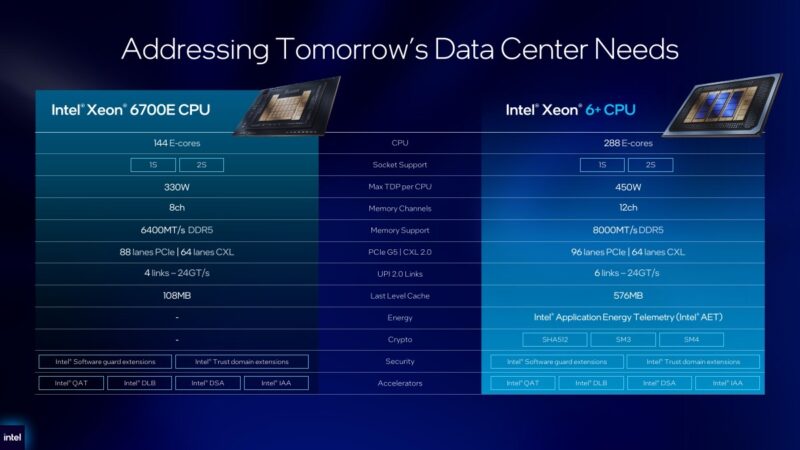
For this new line, the headline features are up to 288 E-cores, DDR5-8000 memory support, and up to 576 MB of last-level cache. Intel is also using the Xeon 6+ launch to bring Intel 18A, PowerVia, and RibbonFET into a shipping data center processor.
Network infrastructure is one of the more obvious targets, since many cores running at specific frequencies are generally used to lower jitter. Sierra Forest found telecom a stronger market segment because of this as well.
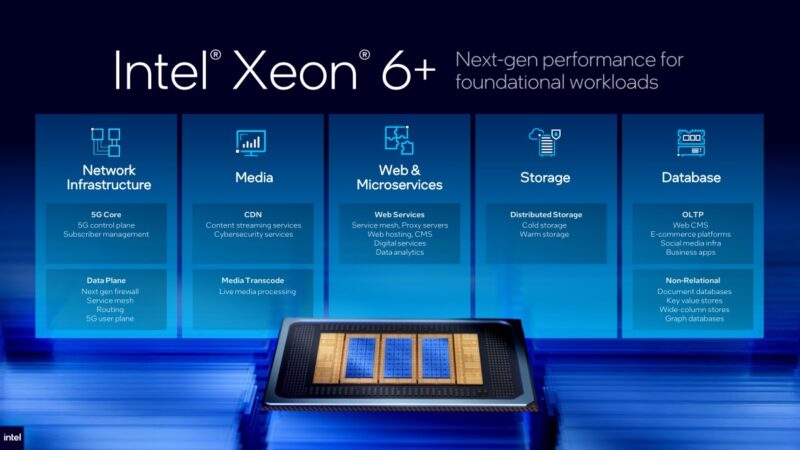
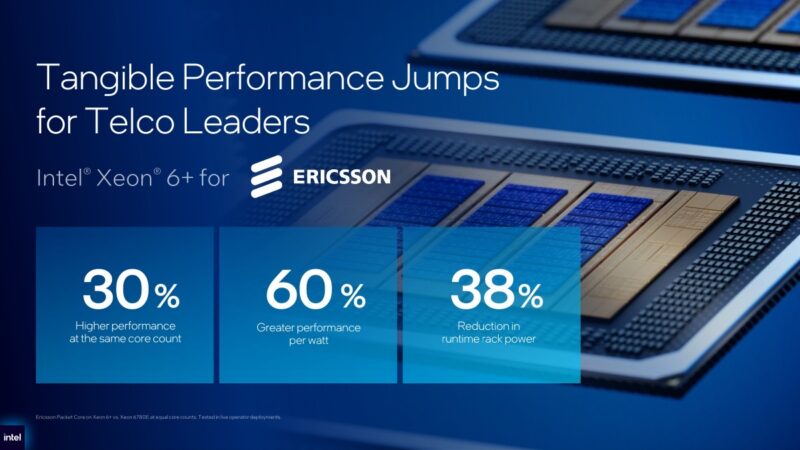
Intel is also making specific telco claims. Intel says Xeon 6+ can deliver 30 percent higher performance at the same core count, 60 percent better performance per watt, and a 38 percent reduction in rack power consumption versus Sierra Forest.
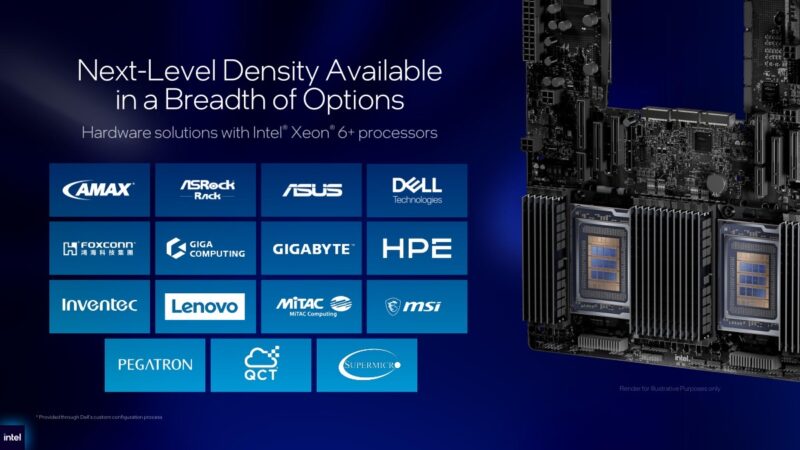
Unlike the off-roadmap Xeon 6900E series, the Xeon 6900E+ series has broader industry support. Partners tell us that supporting the new chips is usually just a BIOS update in existing Xeon 6900P systems.
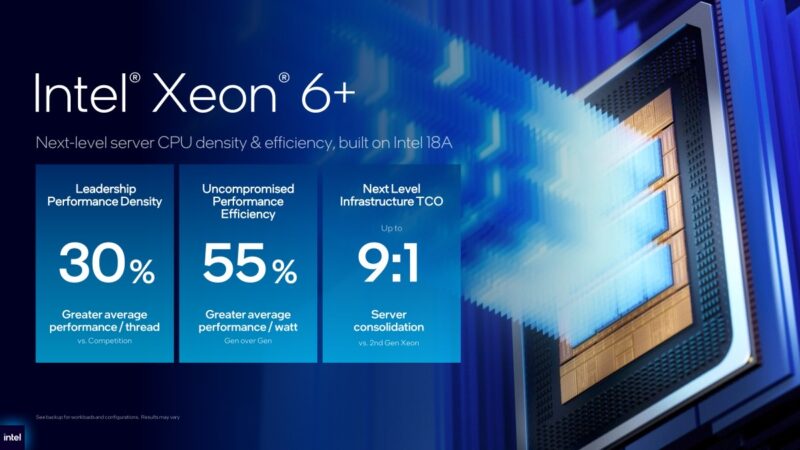
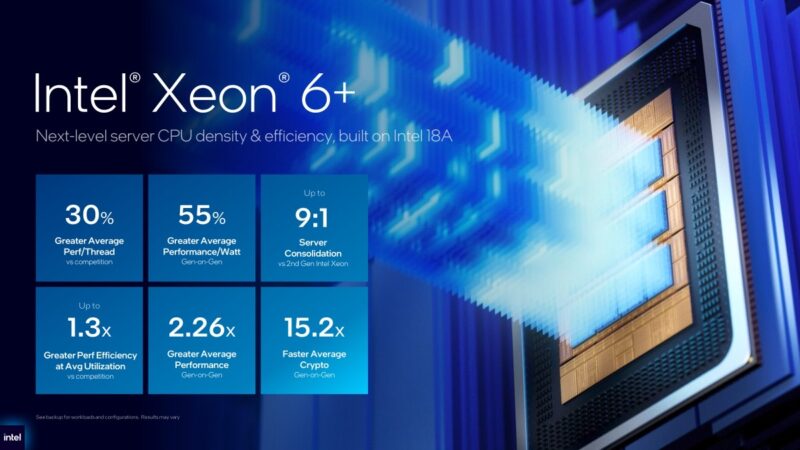
Performance density is where Intel wants the E-core story to land. The company is claiming 30 percent greater average performance per thread, 55 percent greater average performance per watt, and up to a 9-to-1 consolidation ratio versus Cascade Lake.
Architecturally, Clearwater Forest is a big step with newer E-cores, DDR5-8000, and up to 576 MB of last-level cache.
I asked Intel if the Xeon 6900E+ series supports 2DPC on a pre-brief Q&A and was told it does. That may be academic since we have still not seen a 2DPC Xeon 6900 series platform. Still, when I looked up the specs, here is what it said:
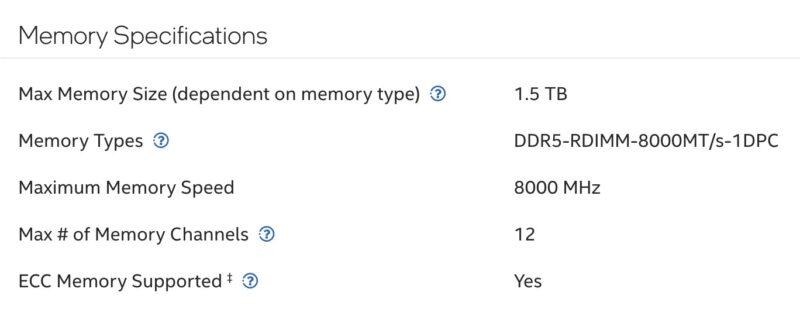
This is actually really interesting. 1.5TB is 12x 128GB ECC RDIMMs. So the maximum memory configuration is 5.33GB/ core of capacity.
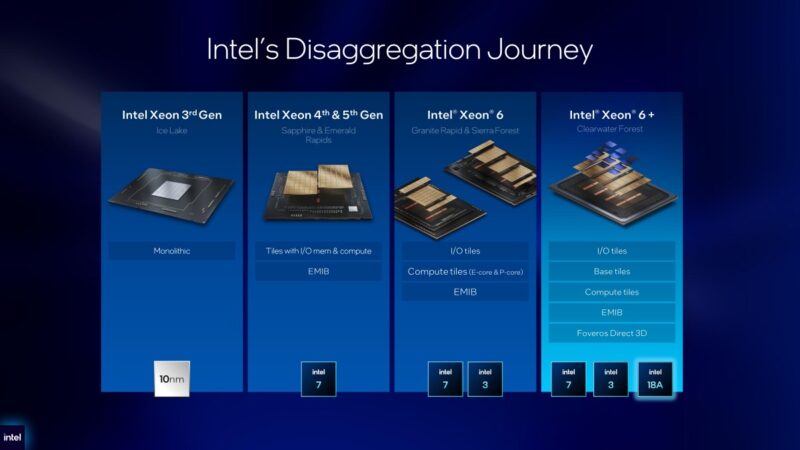
Intel has been moving server CPUs from monolithic dies toward tiled designs for several generations. Clearwater Forest takes that further with compute tiles, base tiles, I/O tiles, EMIB, and Foveros Direct 3D packaging.
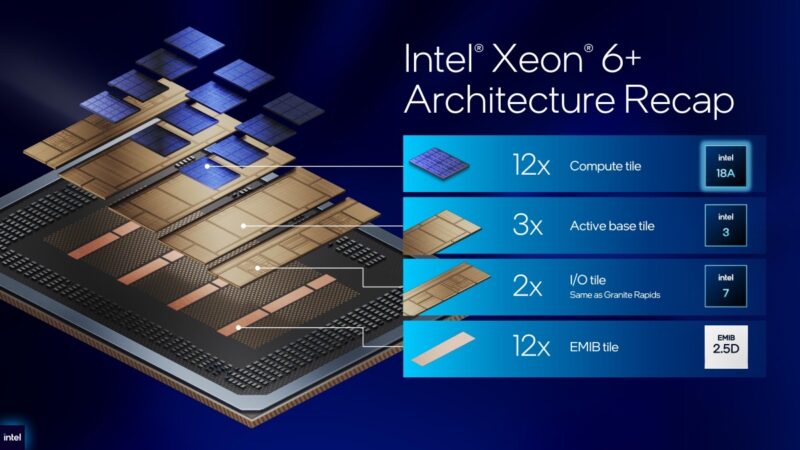
The Xeon 6+ package has 12 compute tiles, three active base tiles, two I/O tiles, and 12 EMIB tiles. Keeping the I/O tile configuration similar to Granite Rapids while scaling the E-core compute side helps explain how Intel is getting to 288 cores and increasing cache by such an enormous degree.
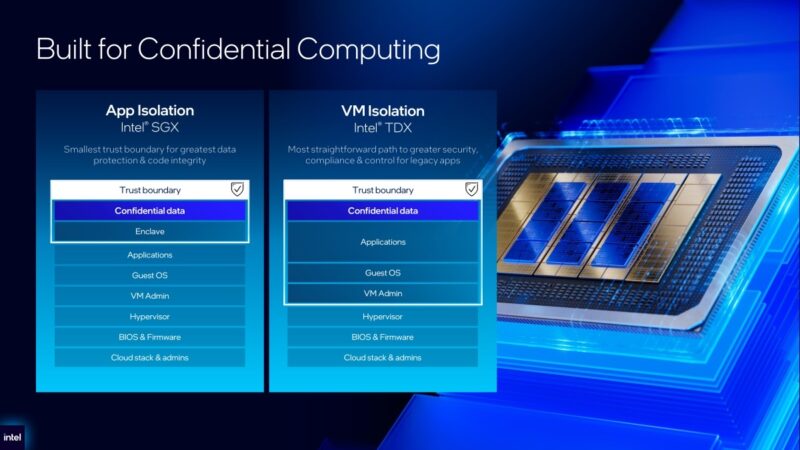
Confidential computing is also part of the platform story. Intel SGX handles application isolation, while Intel TDX is focused on VM isolation with trust boundaries that extend beyond the hypervisor and cloud stack.
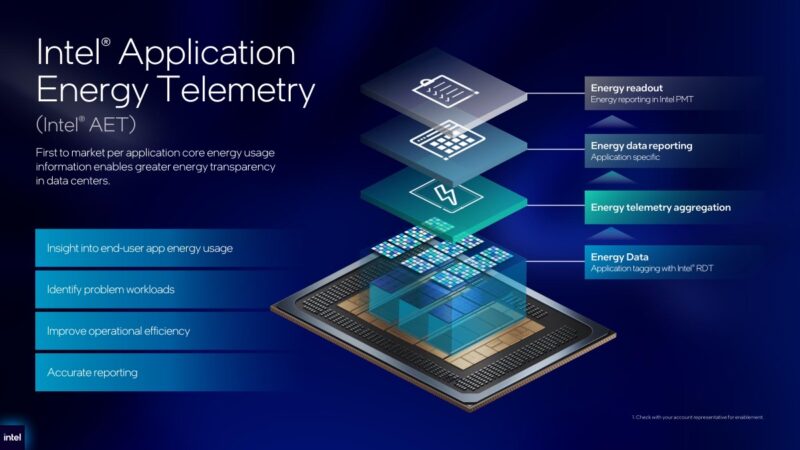
Intel Application Energy Telemetry is one of the more interesting operational features. Instead of only looking at rack or server-level power, large operators can use per-application core energy data for workload placement and cost allocation. Intel says AET will be a feature not just on this Xeon 6+ family, but others going forward.
Here is the comparison between the 2024, Xeon 6700 series socket Sierra Forest and the new 2026 generation Clearwater Forest Xeon 6900E+ series. The new version takes the same E-core approach but pushes it further with more cache, faster memory, and more memory channels.
Really what Intel is saying here is that you can consolidate those two Xeon 6700E sockets to one Xeon 6900E+ socket and save a lot of power in doing so.
Performance and Competitive Positioning
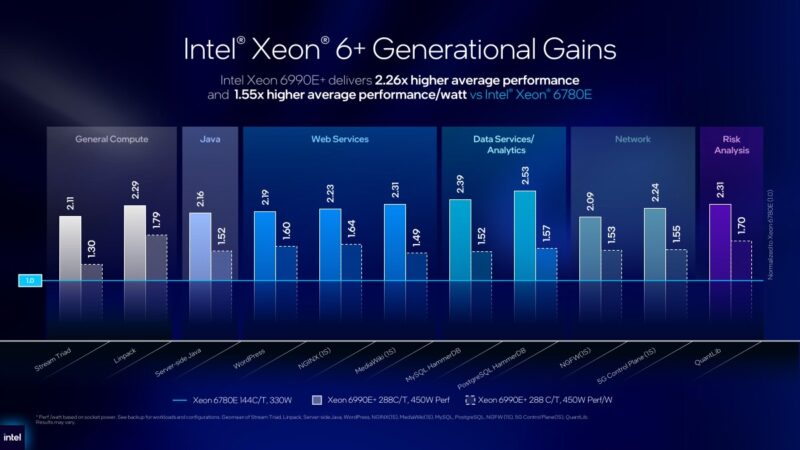
Intel says the Xeon 6990E+ offers 2.26x higher average performance and 1.55x higher average performance per watt than the Xeon 6780E. Since that comparison is 288 cores versus 144 cores, the per-core generational gain is closer to 13 percent if we simply divide the total performance uplift by the core-count increase.
Against AMD, Intel is positioning the Xeon 6990E+ against the EPYC 9965. Intel claims 1.3x higher average performance per thread and 1.3x higher average performance per thread per watt, with the Xeon part at 288 cores and 450W versus AMD’s 192-core, 384-thread, 500W flagship.
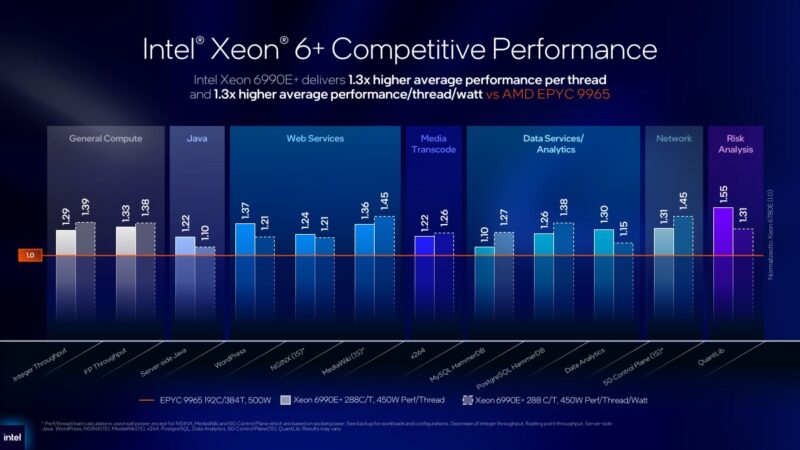
That is a bit of a strange comparison since the Intel Xeon 6990P+ is an E-core non-SMT part while the AMD EPYC 9965 is an SMT=2 part. While the metric is not bad, the per-core performance difference would be a different story since AMD has an SMT core. On the topic of per socket performance, if you limit to threads being equal, then you would compare a full 288-core Intel Xeon 6900E+ to the AMD 9965 at 288 threads. Assuming that was your methodology and reason for picking per thread, not per core, you would not be using 48 cores and 96 threads on the EPYC. Here, Intel seems to be saying that using 384 AMD EPYC threads versus 288 Intel threads, its cores can run faster.
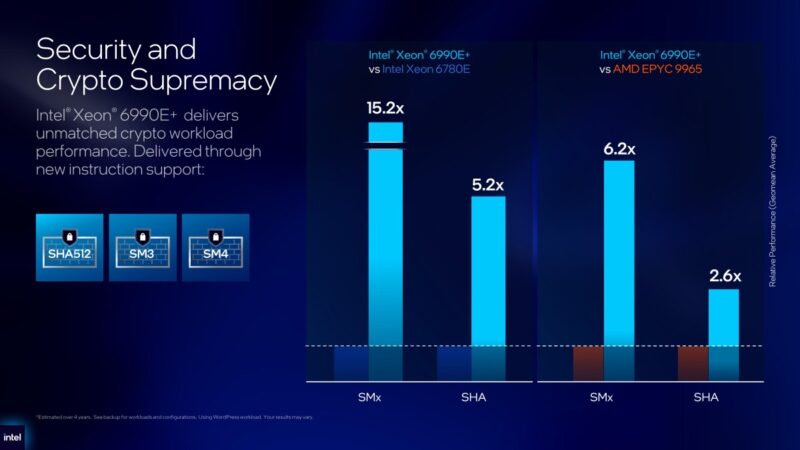
Crypto acceleration is another area where Intel is claiming a large lead. Company data shows a 6.2x gain over EPYC 9965 in SHA512 and SM3, plus a 15.2x gain in SHA workloads versus the prior generation Xeon 6780E.
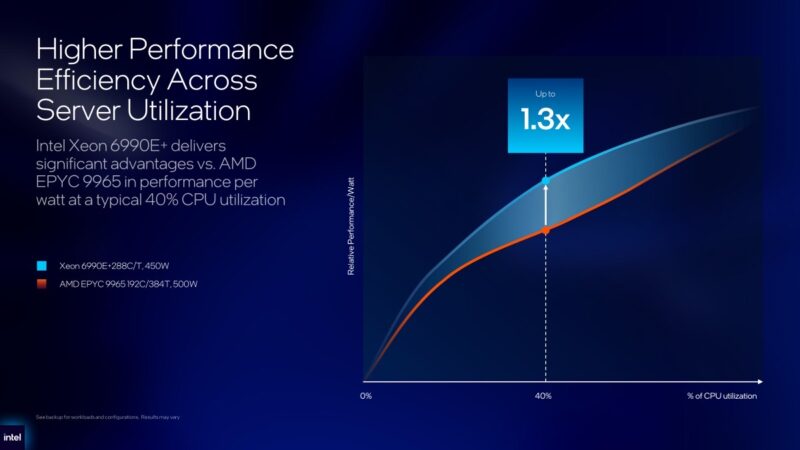
Efficiency across different utilization levels matters because cloud systems are rarely pinned at maximum CPU utilization for long. Intel claims the Xeon 6990E+ maintains a relative performance-per-watt advantage over EPYC 9965 across a range of utilization points.
Intel’s consolidation math is aggressive, but it is also the type of argument that can get attention in large fleets.
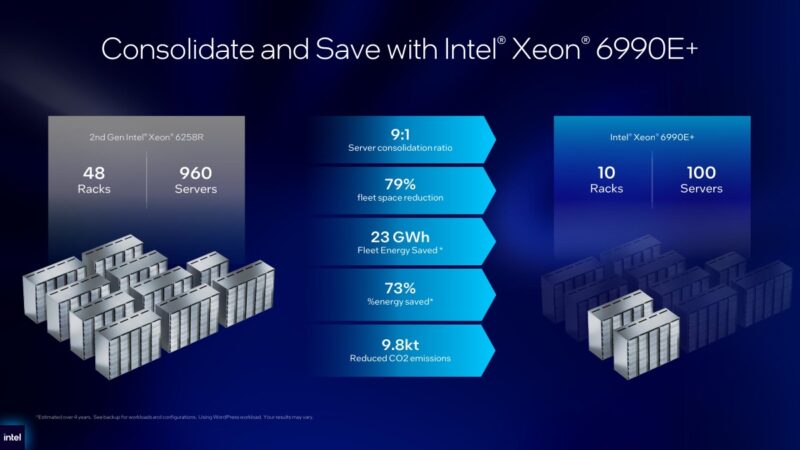
The company says a single rack of Xeon 6990E+ servers can replace 48 racks of 2nd Gen Intel Xeon 6258R systems, or 960 older servers, for targeted workloads.
Intel Xeon 6+ Launch Family
We noticed Intel’s launch deck did not highlight options. Here is what we found with a quick search.
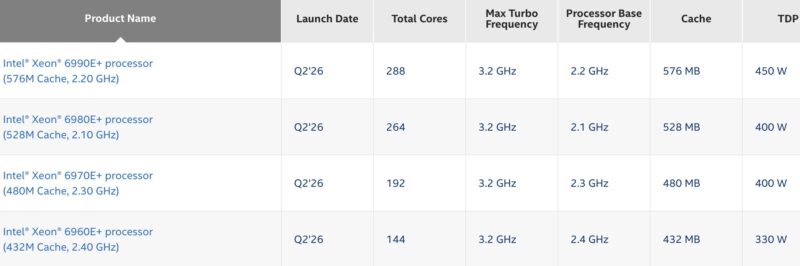
450W may sound like a lot for a processor, but with 288 cores, it is under 2W/core. Also, the family scales down to 144 cores.
Final Words
Intel Clearwater Forest represents a strategic push to keep foundational cloud-native workloads on x86 in the face of growing Arm competition. A Xeon 6900 series AP platform with up to 288 E-cores, 12 memory channels at DDR5-8000, 576 MB of LLC, and Intel 18A process technology is clearly designed to compete on density and efficiency. For the OEMs, this is an easy E-core to support since it is mostly just using a BIOS update.
Generational math still deserves scrutiny. Intel claims 2.26x the performance with 2x the cores going from the Xeon 6780E to the Xeon 6990E+, which implies that the largest benefit comes from core count, memory bandwidth, cache, packaging, and platform-level efficiency rather than a massive per-core jump. Hopefully we get to test these soon.